
Quick answer: THC drinks are technically edibles, but they work very differently. Emulsified THC in a drink is absorbed fast, so you feel it in about 15–20 minutes (vs 45 minutes to 2 hours for a gummy or brownie), the effects are shorter (about 2–3 hours) and more controllable, and the dosing is precise. That makes drinks much easier to pace — sip, wait, adjust — like a cocktail.
This article is part of our complete THC drinks guide. For the overview of formats, dosing, and where to buy, start there.
THC Drinks vs. Edibles at a Glance
| THC drinks | Food edibles (gummies, brownies) | |
|---|---|---|
| Onset | 15 to 20 minutes | 45 minutes to 2 hours |
| Duration | 2 to 3 hours, smooth comedown | 4 to 8+ hours |
| Dosing | Measured per pour or per can | Fixed or uneven doses |
| Pacing | Sip, wait 15 minutes, decide | Long lag makes it easy to overdo |
| The feel | Lighter, social, clear-headed | Heavier, can be sedating at higher doses |
| Best for | Dinner, parties, cocktail-style pacing | Long evenings and experienced users |
Everybody has an edibles story. Maybe you ate half a brownie at a party, felt nothing for an hour, ate the other half, and then spent the rest of the evening wondering if time had stopped. Maybe a friend handed you a gummy and said "just take one" and you spent the next four hours on a couch questioning your life choices. These stories are practically a rite of passage in the cannabis world.
THC drinks get lumped into the same category as edibles, and technically, they are edibles — you're consuming THC through your mouth rather than smoking it. But that's about where the similarities end. The way THC beverages work in your body is meaningfully different from the way a brownie, gummy, or cookie does, and those differences have a big impact on the experience.
If you've been hesitant to try THC drinks because of a bad experience with edibles, or if you're just curious about how the two compare, here's what you need to know.
Why do THC drinks hit faster than edibles?
This is the biggest and most important difference. A food-based edible — a gummy, a chocolate, a cookie — has to pass through your digestive system before the THC enters your bloodstream. That means it has to travel through your stomach, get broken down, and then be processed by your liver. Depending on what else you've eaten, your metabolism, and the specific product, this can take anywhere from 45 minutes to two full hours.
THC beverages work differently. The THC in a well-made drink has been emulsified, meaning it's been broken down into tiny, water-soluble particles. Because these particles are so small, they're absorbed much more quickly through the soft tissues in your mouth, throat, and stomach lining. You don't have to wait for full digestion.
The result? Most people feel the effects of a THC drink within 15 to 20 minutes. That's a dramatically shorter window than a traditional edible, and it makes a real difference in how you experience and manage your high.
Why does onset time matter so much?
Onset time isn't just a number. It's the thing that determines whether you feel in control of your experience or whether you're along for an unpredictable ride.
With food-based edibles, the long wait creates a dangerous temptation: you don't feel anything after 45 minutes, so you eat more. Then the first dose finally kicks in, followed closely by the second, and suddenly you're much higher than you intended to be. That lag between consumption and effect is the reason "start low and go slow" has become the unofficial mantra of the edibles world.
THC drinks shrink that feedback loop dramatically. When you can feel a drink within 15 to 20 minutes, you can make an informed decision about whether to pour another. It's the same kind of real-time feedback you get when drinking a cocktail with alcohol: sip, assess, adjust. That's a much more intuitive and enjoyable way to consume THC, especially if you're newer to it. For more on finding your sweet spot, read our guide to the right dose of THC.
How long do THC drinks last compared to edibles?
Food-based edibles are known for their longevity. Because the THC is processed through the liver and converted into a metabolite called 11-hydroxy-THC (which is actually more potent than the THC you inhale when smoking), the effects can last anywhere from four to eight hours, sometimes longer. For some people, that's a feature. For others, it's the exact reason they avoid edibles altogether.
THC beverages tend to produce a shorter, more manageable experience. Most drinkers report feeling the effects for about two to three hours, with a gentle peak and a smooth comedown. The experience is more comparable to having a couple of cocktails than to taking an edible: it comes on gradually, you enjoy it, and it fades without overstaying its welcome.
This shorter duration is one of the things that makes THC drinks so well-suited for social occasions. You can enjoy an infused cocktail before dinner without worrying that you'll still be feeling it at midnight.
Is dosing easier with THC drinks?
Significantly. This is one of the most underappreciated advantages of the beverage format.
With food-based edibles, dosing can be imprecise. Homemade edibles are notoriously inconsistent — the THC might not be evenly distributed throughout the brownie, so one slice could be much stronger than another. Even commercial edibles, while more consistent, come in fixed doses that may not align with your personal tolerance. You're stuck choosing between the dose they give you and cutting a gummy in half with a kitchen knife.
THC drinks — especially THC spirits — give you much finer control. A 750ml bottle of Artet's Flagship Aperitif, for example, comes with a stainless steel dosing cap that measures out exactly 50ml per pour, delivering precisely 2.5mg of THC each time. You know exactly what you're getting with every single drink. If 2.5mg isn't enough, pour another. If it is, you're done. There's no guesswork, no waiting, and no surprises.
Do THC drinks feel different from edibles?
Many drinkers report that the experience of a THC beverage feels qualitatively different from a food-based edible, even at similar doses. Edibles, especially at higher doses, are often described as a heavy, full-body high that can feel sedating. The liver conversion to 11-hydroxy-THC creates a more intense, sometimes overwhelming experience.
THC drinks, particularly lower-dose ones, tend to produce a lighter, more clear-headed effect. Drinkers often describe feeling social, conversational, and relaxed without the couch-lock sensation that strong edibles can bring on. The experience is closer to the buzz you'd get from a glass or two of wine: present but pleasant, a gentle lift rather than a heavy push.
Of course, these are generalizations. Individual experiences vary based on tolerance, metabolism, and the specific product. But the overall consensus is that THC beverages offer a more controlled, social, and moderate high than their food-based counterparts.
Are THC drinks better than edibles?
Better is subjective, and it depends entirely on what you're looking for. Edibles are great for people who want a long-lasting, potent experience and don't mind the wait. They're portable, discreet, and available in an enormous range of flavors and formats.
THC drinks are better suited for people who value control, pacing, and social experience. They're ideal for anyone who wants to enjoy THC the way they'd enjoy a cocktail: sip by sip, at their own pace, in the company of good food and good people. The faster onset, shorter duration, and precise dosing make them a natural fit for dinner parties, casual evenings, and anyone who's ever been burned by an edible that hit too hard or too late.
If you're someone who loves the ritual of making and drinking cocktails, the beverage format has an added bonus: it's genuinely fun. Building an infused cocktail at home with a THC spirit is a creative act — one that gummies and brownies simply can't offer.
How can I try a THC drink?
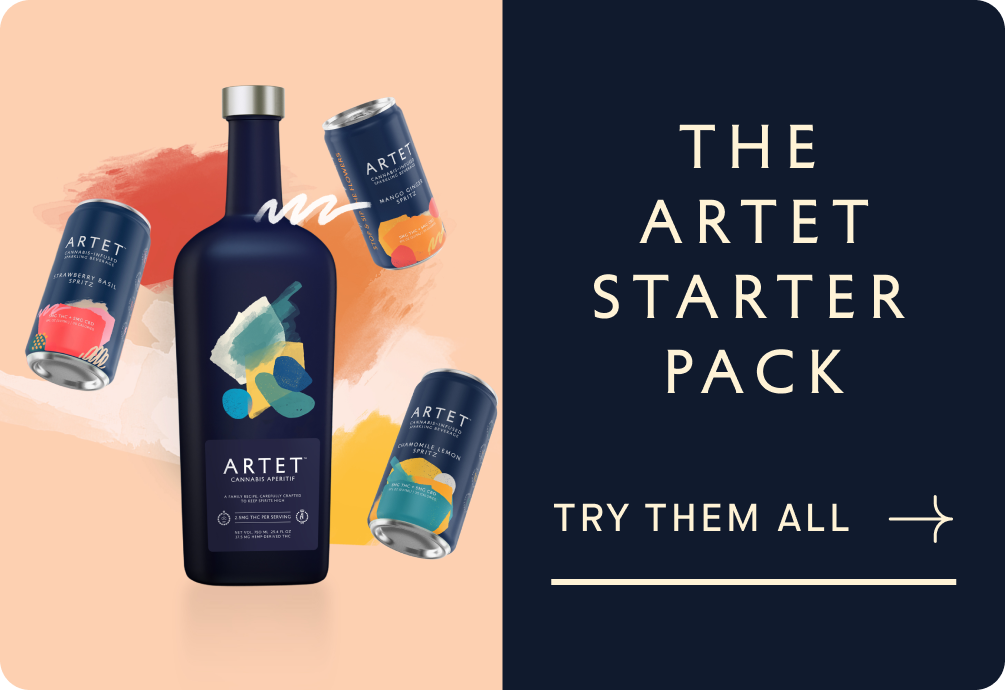
If you're ready to see how the beverage experience compares to edibles, we'd suggest starting with a single, measured pour of our Flagship Aperitif on the rocks. That's 2.5mg of THC in a glass — enough to feel it, gentle enough to stay in control. Or grab the Artet Starter Pack and explore the full range of what infused beverages have to offer, from our 750ml aperitif to our canned spritzes.
And you don't have to take our word for it — Bon Appétit featured Artet in its roundup of the best THC drinks, describing our lineup of gin-inspired botanicals and fresh juices as "bright, complex drinks" with "a balanced, uplifting effect."
We're fairly certain that once you've tried a THC drink, you'll understand why so many people are making the switch. No more waiting, no more guessing, and no more edibles stories you'd rather forget.
Want the bigger picture? Read our complete THC drinks guide — covers formats, dosing, legality, and how to buy.
Cheers, and as always, keep your spirits high!


