
If you've ever been offered a layered, bitter, or botanical drink after a big meal, there's a good chance you've had an amaro. If you liked it, you're in good company. The amaro has gone from a niche, post-shift bartender's drink to one of the most sought-after styles of beverage in the world. For a complete overview of the category, check out our guide to THC drinks.
At Artet, we don't just admire these appetizing drinks from afar. The complexity, the bold flavor profiles, and the food-friendliness of these liqueurs heavily inspired the taste and format of our THC-infused aperitif. Why do drinkers love amari so much, and what exactly makes an amaro special?
What does 'amaro' mean?
It's no coincidence that the word 'amaro' means 'bitter' in Italian.
Amari (to use the proper Italian plural) are made by blending a base spirit with a combination of botanicals: herbs, roots, bark, flowers, citrus peels, and spices. These ingredients impart complexity, edge, and bitterness to the spirit. These blends are then sweetened to take some edge off, while still maintaining a complex flavor profile. When you hear the word 'amaro' in reference to spirits, it's in relation to this broad family of Italian herbal liqueurs.
There's a wide variety of flavors in the wide world of the amaro. Some are dark and syrupy. Others are orange, red, and translucent. Certain amari are extremely herbal, almost medicinal. Others are bright, citrusy, and light enough to drink on the rocks under the sun. What unites them is that bitter, botanical backbone.
How is amaro made?
Makers of amari guard their proprietary blends of botanicals very closely, but the process itself it fairly simple. Take a neutral base spirit and infuse it with a blend of botanicals by way of maceration, distillation, or a combination of both.
The botanical blend is, of course, what makes each drink unique. An amaro can contain as many as several dozen ingredients. Gentian root, wormwood, chamomile, citrus peel, cinnamon, cardamom, mint, rhubarb, and artichoke are all common examples. How do individual botanicals contribute to a drink's flavor? We've written a guide to the botanicals in Artet that will help shed light.
Finally, the liquid is sweetened with sugar or caramel to balance out all that bitterness, then aged. Amari are often bottled at a moderate to low proof ranging between 16% and 40% ABV. Though when it comes to THC-infused beverages like ours, alcohol doesn't factor in!
What are the most famous amaros?
Most liquor stores or cocktail bars will have at least a few of the classics. At better stocked locations, you can find dozens of amaros on the shelf. Here are a few of the most iconic names and what makes each one distinct:
Campari is probably the most recognized amaro in the world, thanks in large part to the crucial role it plays in the Negroni. It's bright red, intensely bitter, and citrus-forward. Campari is technically a pre-dinner drink, but in any case, is the gateway drug for anyone exploring the world of amaros.
Aperol is Campari's lighter, sweeter cousin. Lower in alcohol and gentler on the palate, it's the star of the beloved Aperol Spritz. If Campari is an acquired taste, Aperol is the likely the most accessible of the bunch.
Fernet-Branca is the bartender's handshake — the amaro that industry professionals swear by. It's dark, mentholated, aggressively herbal, and not for the faint of heart. Love it or hate it, Fernet is a rite of passage.
Montenegro strikes a beautiful balance between bitter and sweet. It's smooth, floral, and approachable, with notes of orange peel and vanilla. If you're looking for an amaro that's easy to love, Montenegro is a great starting point.
Cynar is made with artichoke and thirteen other botanicals. It's earthy, slightly vegetal, and surprisingly versatile. Cynar on the rocks with a splash of soda is one of Italy's best-kept secrets.
These are just a few of the most well-known names. The world of amaro is vast, regional, and endlessly rewarding to explore.
What's the difference between an amaro and an aperitif?
This is a question that comes up often, and the answer is that the two categories overlap but aren't identical.
An aperitif is any drink consumed before a meal to stimulate the appetite. Aperitifs tend to be dry, not too sweet, and lower in alcohol. Champagne, dry sherry, and Campari are all classic aperitifs.
An amaro is a specific type of Italian herbal liqueur defined by its bittersweet flavor. Some amaros are served before a meal (making them aperitifs), while others are served after (making them digestifs). It depends on the specific amaro. Campari and Aperol are aperitivo-style amaros. Fernet and many darker, heavier amaros are digestifs, meant to aid digestion after eating.
The simplest way to think about it: all aperitivo-style amaros are aperitifs, but not all aperitifs are amaros, and not all amaros are aperitifs. The categories are about when and how you drink them, not what's inside the bottle.
How do you drink an amaro?
This is the fun part. There's no single right way to enjoy an amaro, and experimentation is encouraged.
Neat or on the rocks is the purist's approach and the best way to really taste what a producer has created. A good amaro is complex enough to sip slowly, and the ice opens up the flavors over time as it dilutes.
With soda or tonic is the Italian way to make a quick, refreshing long drink. Pour an amaro over ice, top with soda water or tonic, and add a citrus garnish. This is aperitivo culture in its simplest form.
In a cocktail is where amaros really shine for mixologists. The Negroni (gin, Campari, sweet vermouth), the Paper Plane (bourbon, Aperol, Amaro Nonino, lemon), and the Black Manhattan (rye, Averna, bitters) are all modern classics that put amaro front and center. Amaros bring depth, complexity, and balance to cocktails in ways that few other ingredients can.
What does amaro have to do with THC?
When we set out to create Artet, we didn't want to make another flavored seltzer or a neutral mixer that disappeared into whatever you poured it into. We wanted to make something with real character — a THC spirit that could stand on its own in a glass and hold its ground in a cocktail.
The amaro tradition gave us the blueprint. We built Artet's flavor profile on the same principles that have made amaros beloved for centuries: botanical complexity, a gentle bitterness that keeps things interesting, warmth from spices like ginger and cardamom, and a balance between sweet and dry that makes you want to take another sip. We swapped the alcohol for THC, but kept everything else that makes these spirits worth savoring.
The result is a drink that shares DNA with Campari, Montenegro, and Fernet, but tastes like nothing else out there. It's our own thing — an amaro-inspired, THC-infused aperitif built for the modern bar cart.
How can I explore the world of amaro?
If you're new to amaros, the best advice is to simply start tasting. Order one after dinner next time you're at an Italian restaurant. Pick up a bottle of Montenegro or Campari and pour it over ice at home. Pay attention to what you taste: the herbs, the citrus, the bitterness, the sweetness. Notice how they interact. That's the experience that makes amaro lovers out of so many people.
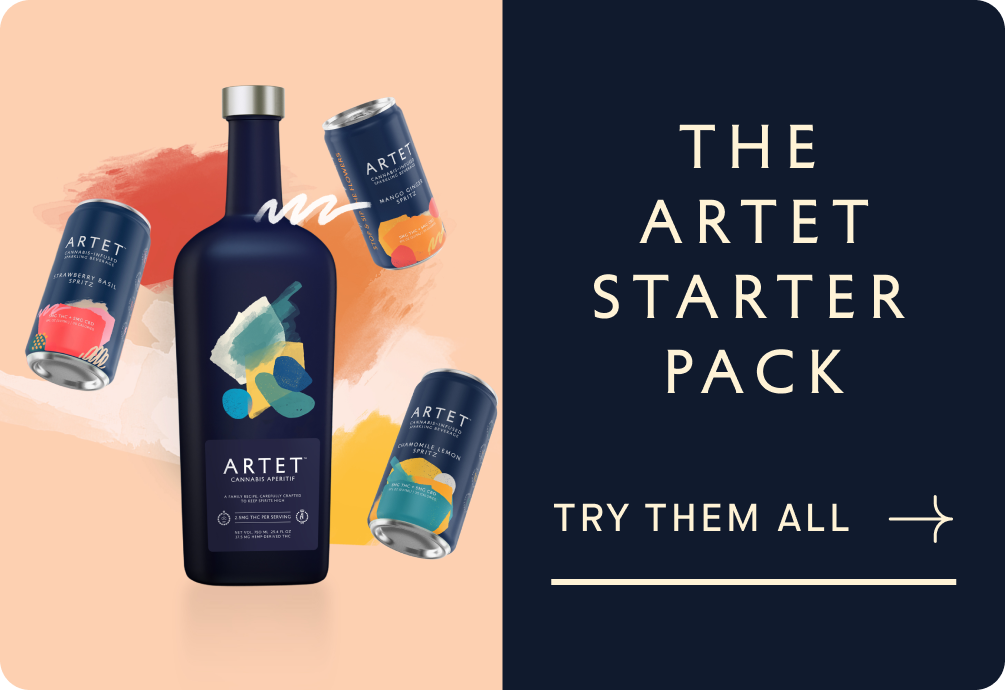
And if you want to experience that same complexity without the alcohol, the Artet Flagship Aperitif or our Starter Pack is a great place to begin. You can sip it neat, pour it on the rocks, or mix it into a cocktail — just like any amaro worth its botanicals.
Cheers, and as always, keep your spirits high!


